#TRUST & SAFETY · Platform Operational Status Report — Vol.22
From child safety standards to local funding monitoring,
I've looked carefully this week as well.
Issue date
2026. 10. 12
Target period
09.27 — 10.10
publication cycle
biweekly
I am sending you this week's safety transaction information.
[Safety transaction information ①] Please check the safety standards for toys marked with '14 years of age or older' and children
Hazardous substances have been identified one after another in tactile toys such as Malangi and Waxbubol, which are popular for relieving stress. In a survey released by the Korea Consumer Agency on Sept. 23, 14 out of 15 products marked their age of use as 14 years or older and were not subject to the Special Act on the Safety of Children's Products. However, all eight Waxbubol products produced methyl isothiazolinone and methylchloro isothiazolinone, which are banned by domestic toy standards, and in a microwave-heated test of seven Malang products, four ruptured within 2 minutes and 30 seconds. In a previous survey by the National Institute of Technology and Standards, the nonconformity rate of children's products was 5.4%, but that of adult products was 17.9%.
💡 Maker
If the actual main user is a child, it is not enough to mark '14 years old or older'. Please mark the KC certification and high temperature/intake precautions appropriate for the age of use on the detailed page and the reward together.
🤝 Supporters
Please check your age and KC mark before funding. Avoid heating or putting it in your mouth.
Detailed standards can be found at the manufacturer center.
[Safety transaction information 2] Fake products, both makers and supporters
In the first half of this year, counterfeit products were detected in Korea worth 159.6 billion won. In the special crackdown by the Korea Customs Service, out of the KRW 153 billion detected, 6,000 K-brand infringing items were KRW 400 million. This means that not only foreign luxury goods but also domestic brands are subject to infringement. Even in Wadiz, intellectual property infringement is the main type of reception for reporting (a total of five reported cases in this period).
💡 Maker
If you prepare genuine and licensed evidence in advance, you can quickly respond to the call request. Please inform me to report any cases of my brand or design being stolen.
🤝 Supporters
Please check again for rewards that are too low below the market price or unclear where the official seller is. If you suspect it, you can submit it to Report on the project page.
I am sharing the case that the trust team confirmed and took action this week.
[Case 1] "Local funding, is it really local?" — Check local fun usage criteria
While monitoring a project to locally fund desserts made from local specialties, we confirmed that no data was submitted to confirm the local production, such as a certificate of origin. The trust team said it needed to confirm whether the reward was a product directly produced in the region and requested additional data. Since then, we have confirmed that the address of the workplace matches the area with the registration certificate of the agricultural management company and proceeded with local funding. As it is a product made directly from the production area in each region, we will continue to check carefully to see if it was born and raised in the region.
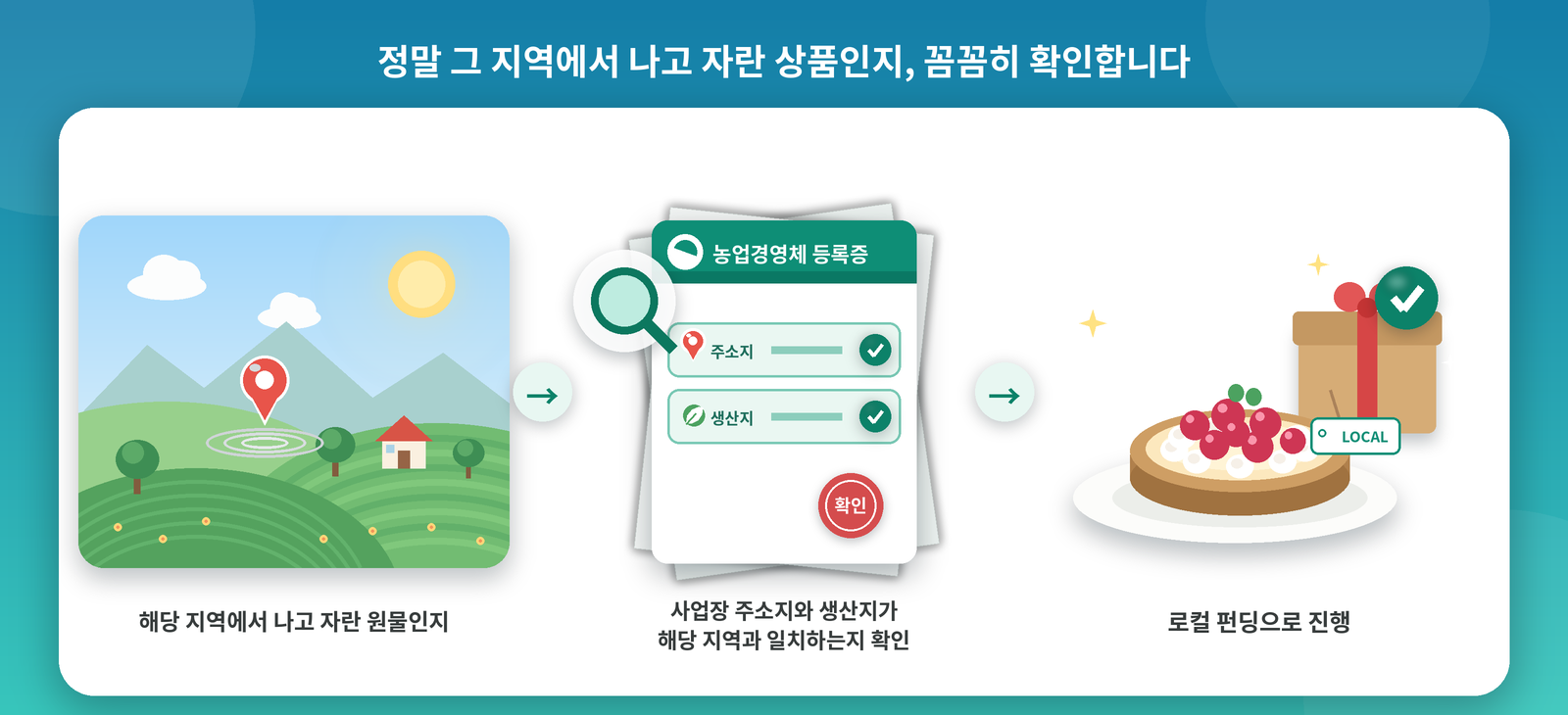
💡 Local funding has changed
Local funding has established standards to be available only for projects that introduce regions to suit their names. Previously, it was available without restrictions outside of Seoul, Gyeonggi, and metropolitan cities, but now you have to meet all of the following conditions.
Areas outside of Seoul, Gyeonggi-do, and metropolitan cities
Target category food (first farm, water, livestock products, direct processing and manufacturing foods, local restaurants, traditional liquor), travel (domestic travel, activity)
Project Conditions ① Project to introduce rewards made from raw materials produced and collected in the relevant area ② Project to contribute to regional problem solving and co-prosperity
Additional document submission is required to check whether the criteria are met, such as the location of the document verification workplace and the origin of the reward, and if the conditions are not met, it will be changed to the default pricing plan.
[Case 2] "Can I use this design?" — Copy production declaration and license verification
For a module shelf reward project, a report has been received that it appears to be made by copying a product on a specific site. Based on the report, the trust team asked the maker for data to verify the manufacturing process and usage rights. As a result of checking, it was confirmed that the maker officially purchased the commercial license of the site and produced the product within that range. Accordingly, Wadiz made the project proceed normally without any action. Even if a report is received, we do not immediately sanction it just because it looks similar, but we judge it after checking the rights relationship.
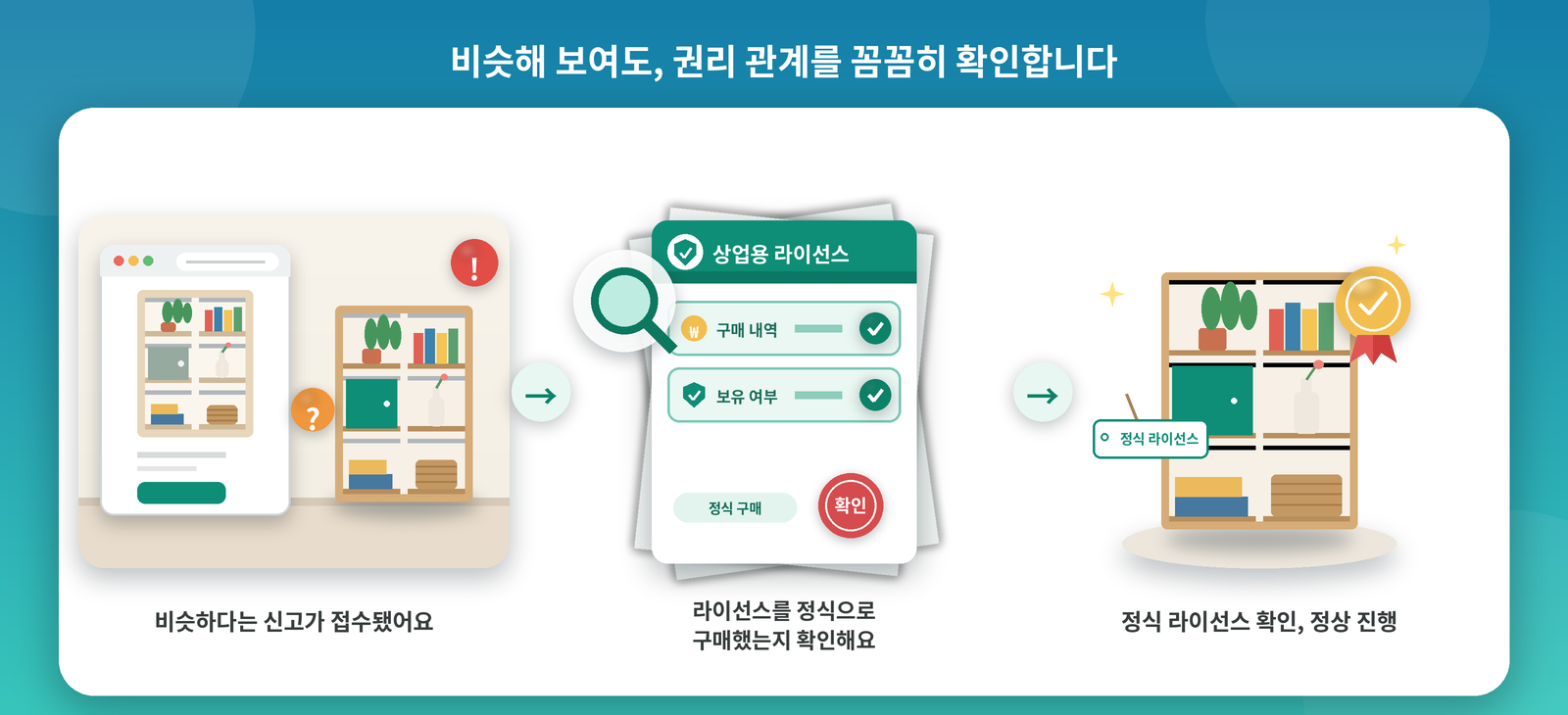
💡 What if you have a license even though it looks similar?
Even if the design looks similar, it may not be a problem if you have the right to use it. However, since each license has different conditions such as commercial availability, production and sales scope, and labeling obligations, Wadiz checks the purchase details and license scope together. Manufacturers can respond quickly when there is a request for clarification by preparing data in advance that can check the license purchase history and scope of use.
This week's issue, I'll just point out the point.
This week, the safety standards for children and counterfeit products for tactile toys were pointed out as safety transaction information, and we looked at the improvement of the standards for using local plans and the confirmed cases accordingly. Safety standards cannot be replaced only by indicating the age of use, and it is safe to prepare proof of genuine product in advance.
The local plan has adjusted the standards so that only projects that really introduce the region can be used. I'll check carefully one by one with documents to see if the product is produced in the region.
In addition, even if a report of suspected copycat production is received, Wadiz does not immediately sanction it, but determines it after checking the rights relationship such as licenses.
The following Transparency Report will come on October 26, 2026.
The trust team will continue to deliver the news transparently and continue to build an environment where both makers and supporters can feel safe.
The trust team will continue to deliver the news transparently and continue to build an environment where both makers and supporters can feel safe.
 Kakao Channel
 Facebook
 Brunch
 Instagram
 Blog
Blog YouTube
 X
X 링크드인
링크드인 Android App
 iOS App
