
#TRUST & SAFETY · Platform Operational Status Report — Vol.20
From disclosure of post-operation standards to food and overseas product issues,
This week, we looked closely at the overall safety transactions.
Issue date
2026. 09. 14
Target period
08.30 — 09.12
publication cycle
biweekly
From September, we will provide you with new information on safety transactions.
Revised E-Commerce Act requires disclosure of later operating standards
The revised E-Commerce Act comes into force on July 21, 2026, and all operators who post reviews are obliged to disclose their review operating standards to consumers.
What should I reveal?
There are four targets for disclosure. Who can write a review (the author's scope), how much exposure (posting period), what criteria are evaluated and sorted (grade evaluation criteria and their effects), in which case it is deleted and how it can be challenged (deletion criteria, objection process).
What if you use AI and algorithms?
If you select best reviews or order exposure with AI or algorithms, abstract explanations such as 'utility' are not enough. Judgment factors such as actual experience, details of explanation, appropriateness of photos and videos, and number of inquiries and recommendations should be revealed in detail. In particular, choosing only positive reviews and posting them may violate the law, such as deleting negative reviews.

💡 When will it be applied?
The guidance period ends on October 21, 2026, and will be fully applied from October 22. Wadiz is also preparing standards for supporters' reviews, and please refer to the Maker Center and Help Center notices for more information.
This is the news from the last case.
NMN ingredient expression and guidelines have been established
Regarding the case of anti-aging expression of NMN components covered in Transparency Report Vol.18, Wadiz has newly established guidelines for relevant expression standards, as NMN has not been recognized for its functionality by the Ministry of Food and Drug Safety in Korea. Please refer to the notice below for more information.
I am sharing the case that the trust team confirmed and took action this week.
[Case 1] "Cancer cell inhibitory effect"—claiming the efficacy of food to treat diseases
It has been confirmed that the health juice project made of fish raw materials is strongly appealing for anticancer effects based on overseas academic papers. If a paper claiming the effect of anticancer and cell death on human cancer cells is linked to a reward or a phrase such as 'inhibition of cancer cell proliferation', consumers may misunderstand as if regular food is a drug that prevents and treats cancer. Wadiz asked for an exclusion not to use the paper as an efficacy basis.
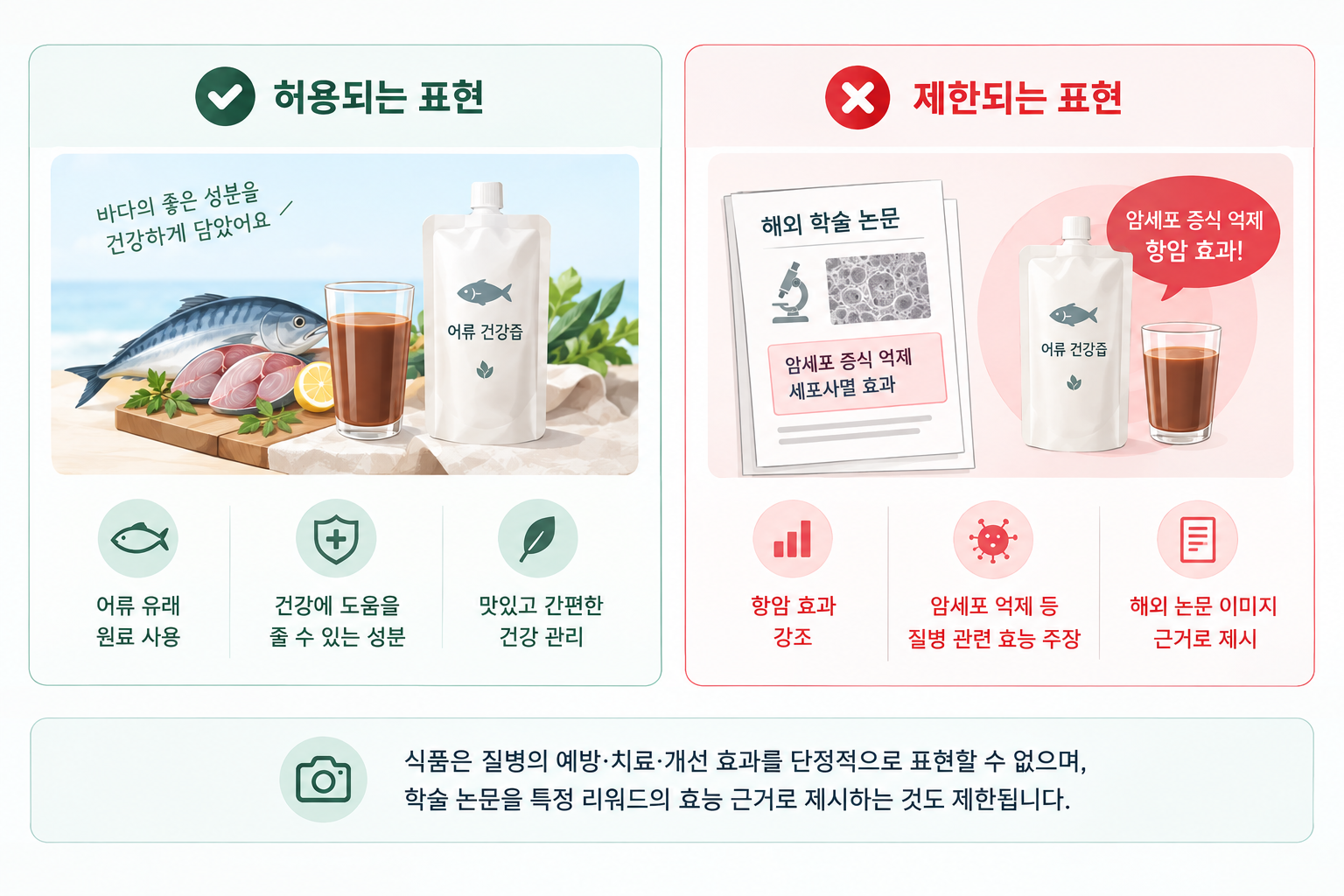
💡 Why is the expression of disease efficacy prohibited in food?
Under the Food Labeling and Advertising Act, food categories cannot definitively express the effects of preventing, treating, or improving diseases, or use phrases claiming efficacy against certain diseases such as cancer. Even if academic papers or research results are cited, presenting them as evidence of efficacy of a particular reward will equally limit consumers to misidentify the food as having a drug-level therapeutic effect.
[Case 2] "It's a kitchen knife, but you can't sell it?" — Failure to meet the criteria for bringing foreign goods into Korea
An overseas manufacturer tried to sell a jackknife (kitchen and household knife) reward, but confirmed that it did not meet the domestic standards. According to the Enforcement Decree of the Act on the Safety Management of Guns, Sword, and Firearms, jackknives with blades of 6cm or more are classified as swords, and domestic sales may be restricted without permission to possess swords. Wadiz unexposed the corresponding rewards that did not meet the criteria.
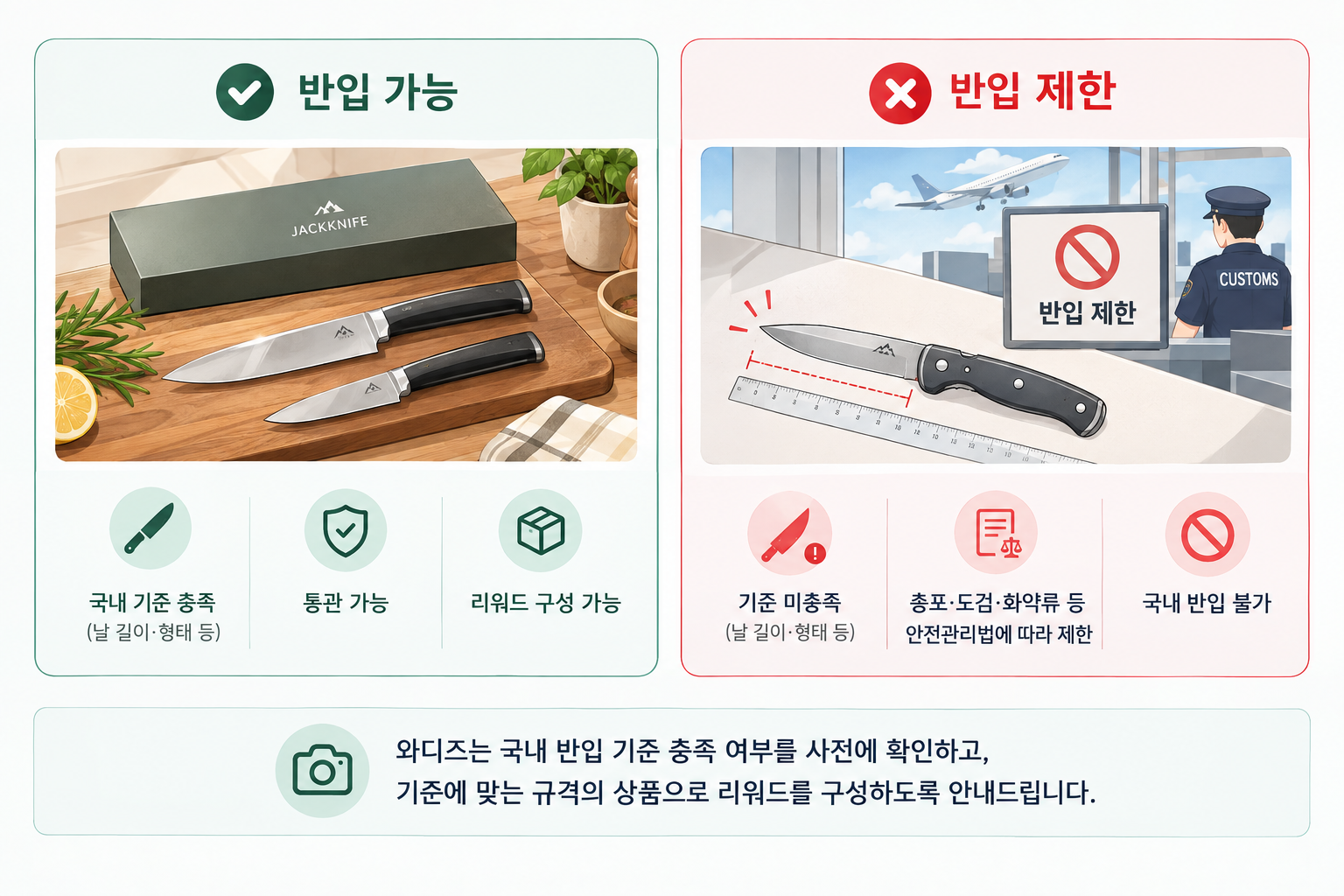
💡 Why do household knives also have customs clearance standards?
Even kitchen knives and living knives can be classified as safety management targets such as swords in Korea depending on the length and shape of the blade. Failure to meet this standard may result in restrictions on entry at the customs clearance stage, preventing the normal delivery of rewards to supporters. When configuring overseas products as rewards, please check the standards for bringing into Korea in advance, and refer to the Wadiz Overseas Shipment Project Guide below for more information.
This week's issue, I'll just point out the point.
This week, we looked at regulatory trends and cases together. As disclosure of late-stage operating standards is mandatory under the revised E-Commerce Act, Wadiz is also reorganizing related standards.
In terms of cases, two cases were confirmed: the claim of the efficacy of food for treating diseases and the failure to meet the standards for bringing overseas products into Korea. Whether the basis is academic data or foreign standards, failure to meet domestic laws and standards can limit expression or make the reward itself difficult, so we will continue to look closely at this part.
In addition, with regard to the case of anti-aging representation of NMN components covered in the last Vol.18, the guidelines for the relevant representation criteria have also been newly compiled. If you are preparing related rewards, please refer to the guidelines above.
In addition, with regard to the case of anti-aging representation of NMN components covered in the last Vol.18, the guidelines for the relevant representation criteria have also been newly compiled. If you are preparing related rewards, please refer to the guidelines above.
The following Transparency Report will come on September 28, 2026.
The trust team will continue to deliver the news transparently and continue to build an environment where both makers and supporters can feel safe.
The trust team will continue to deliver the news transparently and continue to build an environment where both makers and supporters can feel safe.

Review previous report
 Kakao Channel
 Facebook
 Brunch
 Instagram
 Blog
Blog YouTube
 X
X 링크드인
링크드인 Android App
 iOS App
