#TRUST & SAFETY · Platform Operations Report — Vol. 18
From exaggerated claims of efficacy to similar images,
this week we took a close look at these two areas.
Publication Date
August 24, 2026
Coverage Period
August 16 — August 22
Publication Frequency
Every Monday
Here are the cases the Trust Team identified through monitoring this week.
[Case 1] “Does NMN Prevent Aging?” — Anti-aging claims for an ingredient not certified by the Korean Ministry of Food and Drug Safety
We identified numerous instances in Rewards campaigns containing NMN where claims such as “anti-aging” and “age-defying” were used to promote anti-aging effects. NMN is an ingredient that has not yet been recognized by the Korean Ministry of Food and Drug Safety (MFDS) for any related functional benefits; therefore, emphasizing anti-aging effects may violate the Health Functional Food Act and the Labeling and Advertising Act. wadiz is guiding campaign creators to revise such claims to focus on the ingredient and its content, and we are continuously monitoring efficacy claims that could mislead consumers.
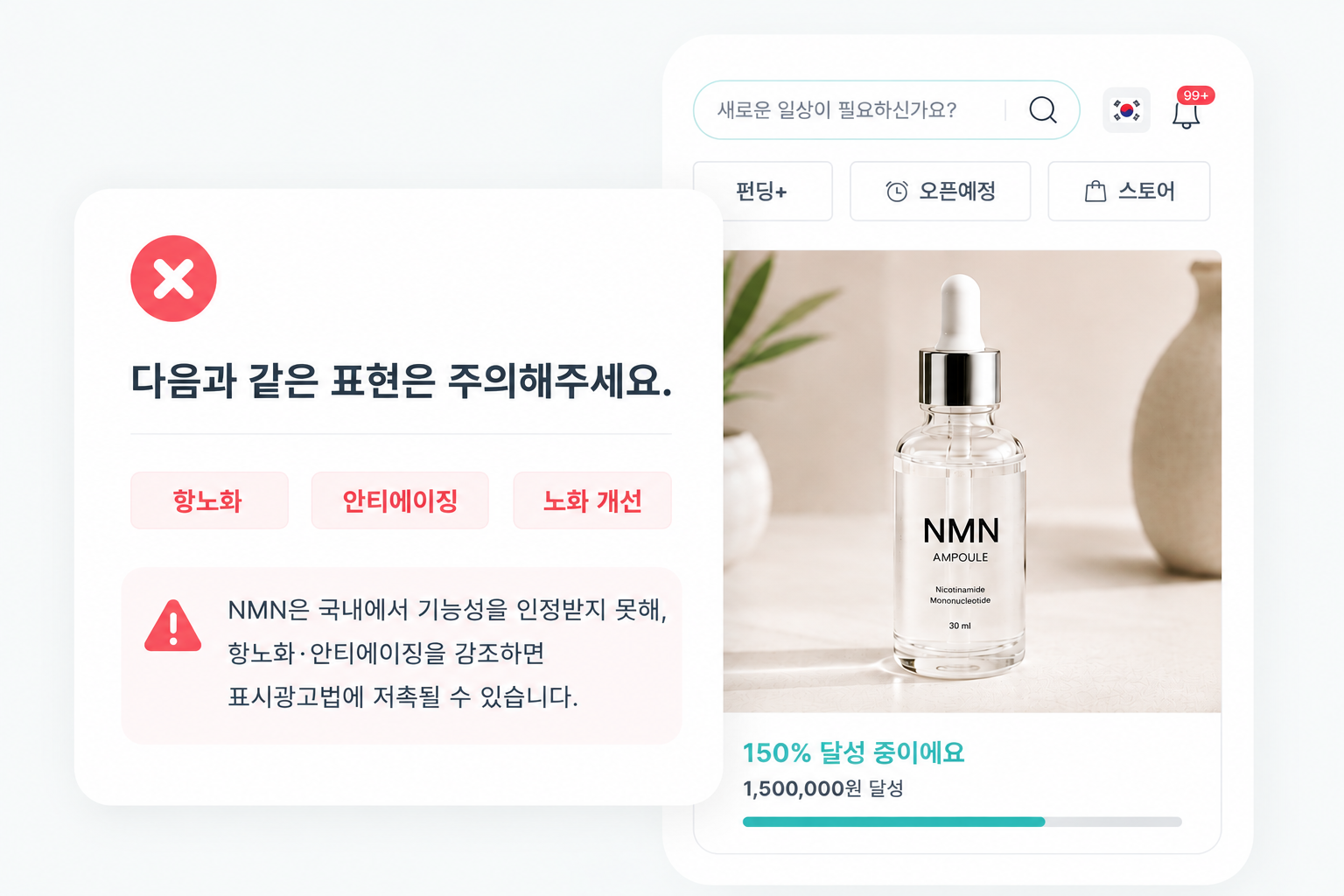
💡 Why are ingredients studied overseas restricted in Korea?
Claims regarding the functional benefits of health functional foods may only be made within the scope recognized by the Korean Ministry of Food and Drug Safety, regardless of overseas certifications or research results. If the efficacy of an ingredient not recognized in Korea is highlighted, consumers may mistake unverified effects for actual benefits.
💡 Important Note
When using NMN as a reward, please avoid expressions that imply aging or anti-aging. Instead, specify the ingredient and its content—such as “Contains 500 mg of NMN”—or focus on the user experience, such as “Easy to take.”
[Case 2] “This image looks familiar…” — Review of a Report on the Use of Similar Images
A report was filed stating that the story image for a food rewards project was nearly identical to an image from another company, differing only in the rewards product section.
As an intermediary platform, wadiz does not directly determine whether copyright infringement has occurred, but upon receiving a report, we carefully compare the two images to assess their similarity. If substantial similarity is confirmed, we request the maker to provide an explanation of the source, and if the explanation is insufficient, we require the image to be modified.
As an intermediary platform, wadiz does not directly determine whether copyright infringement has occurred, but upon receiving a report, we carefully compare the two images to assess their similarity. If substantial similarity is confirmed, we request the maker to provide an explanation of the source, and if the explanation is insufficient, we require the image to be modified.

💡 Is it okay to use an image from another source and make minor changes?
Even if an image is publicly available online, using it without permission and modifying only a small part can lead to copyright issues. Simply replacing the product while keeping the composition and layout unchanged may constitute a violation of “edited copyright.” Therefore, please use only images you have created yourself or for which you have obtained legitimate usage rights.
Here’s a brief summary of this week’s issues.
This week, we focused on examining exaggerated claims of efficacy and image similarities. We checked each case individually to determine whether the efficacy of ingredients not recognized in Korea had been exaggerated and whether reports of similarities to other companies’ images were actually substantiated.
The reason is the same for both cases. Since unsubstantiated claims or unverified reports of similarity can erode supporters’ trust, we are conducting even more thorough checks on cases where the judgment is ambiguous.
The next Transparency Report will be released on August 31, 2026. We will continue to communicate transparently and build an environment where both makers and supporters can feel at ease.
 Kakao Channel
 Facebook
 Brunch
 Instagram
 Blog
Blog YouTube
 X
X 링크드인
링크드인 Android App
 iOS App
